




03 — Energy & Biofuel
Green fuels from a single feedstock
Aviation fuel from hemp-seed oil — one bio-derived input, a full fuel slate out.
A HEFA route that turns 100% pure hemp-seed oil into gasoline, diesel and up to 75% Jet A-1, plus a hemp-derived vegetable charcoal. Bio-derived industrial chemistry, validated at independent laboratories — not a consumer product.
The energy work I am most invested in is producing green fuels from 100% pure hemp-seed oil — diesel, Jet A-1, gasoline and minor gas fractions from a single bio-derived feedstock.
I present this as bio-derived industrial chemistry and green-fuels R&D: a feedstock, a reaction, a separation, and an independent validation. The headline is an aviation biofuel produced by HEFA — hydrotreatment of fatty acids — and the supporting work is a hemp-derived solid fuel aimed at industrial heat.
The discipline is the same one I apply across all the chemistry: define the input, run the reaction that converts it, choose the separation that isolates each product cleanly, and prove the result on real equipment and at outside laboratories rather than on a slide. Where a method is novel, I describe what it does and how it was validated, and hold the specifics as proprietary.
None of this is framed as a consumer-cannabis product. It is industrial chemistry on an agricultural feedstock — a crop in, a fuel slate out — judged on process rigor and on numbers a third party measured.
Jet A-1 aviation-fuel yield isolated by the HEFA fractional column
pure-hydrogen pressure in the hydrotreatment reactor
reactor temperature over molybdenum and platinum catalysts
calorific value of the hemp-derived vegetable charcoal
Jet A-1 from 100% hemp-seed oil, by HEFA.
The route is HEFA — hydrotreatment of fatty acids — and it starts and ends with a single bio-derived input.
Hemp-seed oil enters a chemical reactor charged with molybdenum and platinum catalysts at roughly 280 °C and about 2,800 PSI of pure hydrogen. Hydrotreatment of the fatty acids produces long-chain fatty-acid bases — the hydrocarbon backbone the rest of the process refines.
From there the stream runs through deoxygenation, then vacuum distillation, and finally fractional distillation. The fractional column is where the route pays off: it isolates the phases — gasoline, diesel, and most importantly up to 75% yield of Jet A-1 aviation fuel — with minor gas fractions lost in the vacuum stage. The work has been tested at Cornell University in the United States and at the Intertek and Proacem laboratories in Colombia. Some methods I hold as proprietary.
HEFA — hemp-seed oil to aviation fuel
- 01 Feedstock 100% pure hemp-seed oil as the single bio-derived input — no fossil co-feed.
- 02 Hydrotreatment Reactor with molybdenum and platinum catalysts at ~280 °C and ~2,800 PSI of pure hydrogen.
- 03 Fatty-acid bases Hydrotreatment of the fatty acids produces long-chain fatty-acid bases.
- 04 Deoxygenation Oxygen is stripped from the chains to leave hydrocarbon-grade material.
- 05 Vacuum distillation Distillation under vacuum; minor gas fractions come off at this stage.
- 06 Fractional distillation The fractional column isolates the phases: gasoline, diesel, and up to 75% Jet A-1.
One input, four phases out.
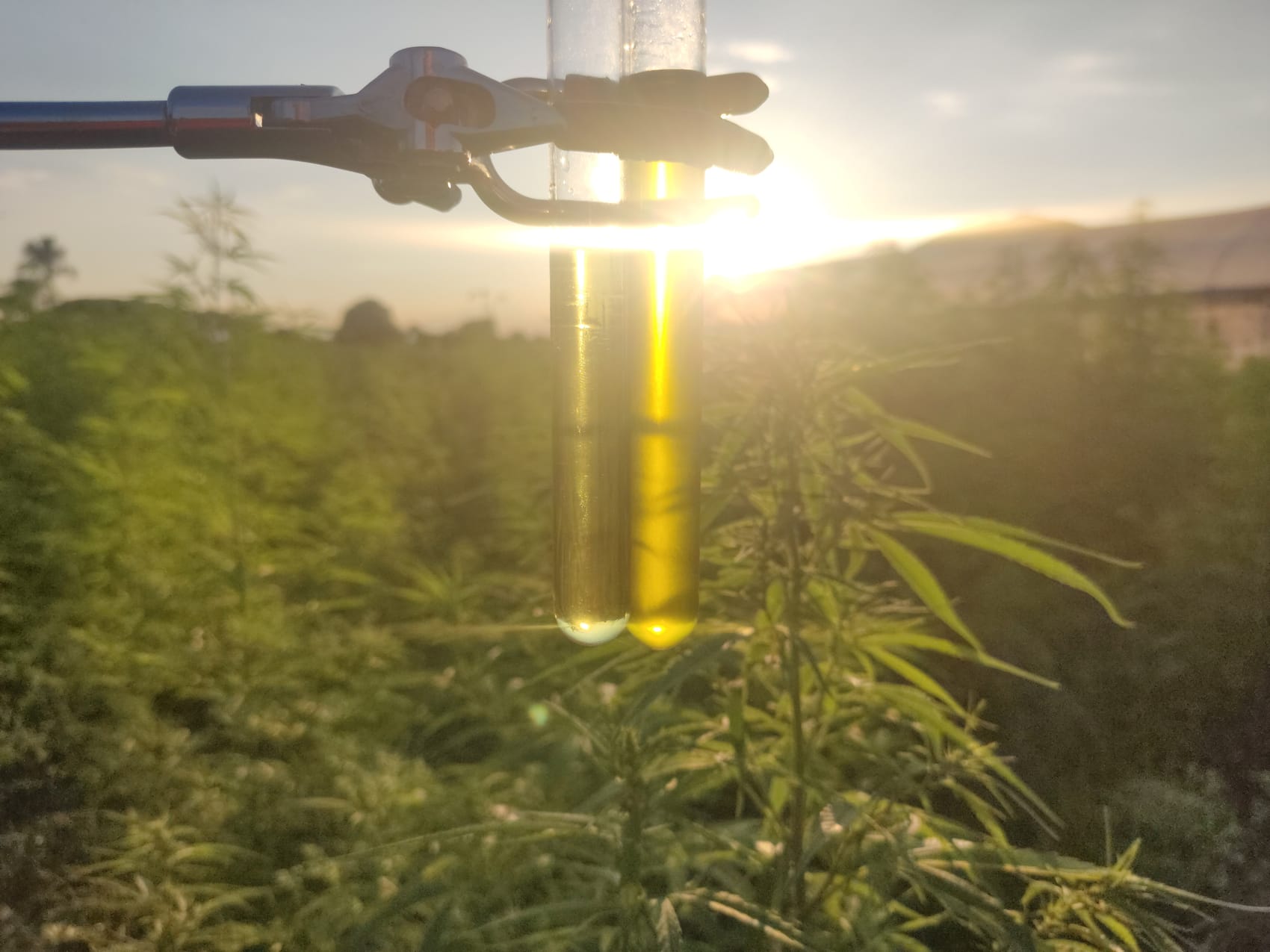
100% hemp-seed oil
The whole slate traces back to a single bottle of oil.
Starting from one feedstock — pure hemp-seed oil — the process separates a full fuel slate. The headline is the Jet A-1 fraction, but the diesel, gasoline and minor gas phases come off the same reaction and the same column.
Because there is no fossil co-feed, the carbon in every fraction came from the crop. That is the part that makes it bio-derived in the strict sense, not blended down from petroleum.
- Single feedstock: 100% hemp-seed oil
- No fossil co-feed in the reactor
- One reaction, one column, four phases
- Carbon sourced entirely from the crop
HEFA process — operating envelope
- Feedstock
- 100% hemp-seed oil
- Process
- HEFA — hydrotreatment of fatty acids
- Catalysts
- Molybdenum + Platinum
- Reactor temperature
- ~280 °C
- Hydrogen pressure
- ~2,800 PSI (pure H₂)
- Intermediate
- Long-chain fatty-acid bases
- Separation
- Deoxygenation → vacuum → fractional distillation
- Jet A-1 yield
- up to 75%
- Co-products
- Gasoline · Diesel · Gas fractions
- Validation
- Cornell · Intertek · Proacem
Oil and hydrogen in, hydrocarbon bases out.
The reactor is the heart of the route, and it reads more clearly as a diagram than as a photograph. Two inputs go in — hemp-seed oil and pure hydrogen — and they meet a fixed bed of molybdenum and platinum catalyst held at roughly 280 °C and about 2,800 PSI. The schematic below traces that flow and the long-chain fatty-acid bases it produces.
Hydrotreatment of fatty acids
A catalytic bed under hydrogen, at temperature and pressure.
Inside the reactor, hydrogen is forced over the fatty acids in the hemp-seed oil at ~2,800 PSI while the molybdenum and platinum catalysts and the ~280 °C temperature drive the hydrotreatment. The reaction saturates and rearranges the fatty-acid chains into long-chain fatty-acid bases.
Those bases are not yet fuel — they still carry oxygen. They are the intermediate the deoxygenation and distillation stages downstream convert into the finished hydrocarbon slate.
- Hemp-seed oil + pure H₂ as the two inputs
- Mo and Pt catalyst bed at ~280 °C
- ~2,800 PSI of pure hydrogen
- Output: long-chain fatty-acid bases
A column drawn, not photographed.
After hydrotreatment the deoxygenated stream is split by boiling point in a fractional-distillation column. Heat at the base drives vapor upward; as it rises it cools, and each fraction condenses at the tray matching its boiling band. The lightest cut leaves at the top and the heaviest at the bottom — which is exactly how the slate gets separated into gasoline, jet and diesel.
Fractional distillation
How one stream becomes gasoline, jet and diesel.
The deoxygenated material enters the column and rises as vapor. Gasoline, the most volatile fraction, condenses high in the column; the Jet A-1 cut — up to 75% of the stream — condenses in the middle band; diesel, the heaviest liquid fraction, falls to the lower trays.
The minor gas fractions have already been removed upstream in the vacuum stage, so the column is splitting the liquid slate. Where each cut is drawn sets the product, which is why a single column produces three fuels instead of one.
- Separation by boiling point, tray by tray
- Gasoline high, Jet A-1 mid, diesel low
- Jet A-1 is up to 75% of the stream
- Gas fractions removed upstream by vacuum
Four fractions off one column.
The output is not a single product but a slate, and each fraction earns its place by where it condenses. Read across the tabs, the column is splitting one deoxygenated stream into four cuts — three liquid fuels and a minor gas stream — by nothing more exotic than boiling point.
The fraction the whole process is built around
Jet A-1 is the headline cut. The fractional column isolates it at up to 75% yield from the deoxygenated, distilled stream — the largest single phase the process produces, and the one that justifies the route.
It is a kerosene-range fraction drawn off the column at the tray matching its boiling band, between the lighter gasoline cut above it and the heavier diesel below.
- Up to 75% yield from the fractional column
- Kerosene-range aviation cut
- The reason the HEFA route was developed
The heavier hydrocarbon cut
Diesel comes off the column as a heavier fraction than the jet cut, condensing lower down where the boiling temperatures are higher. It is a co-product of the same single feedstock, not a separate process.
Drawing it from the same column means the fuel slate is set by where the cuts are taken, not by running the plant differently for each product.
- Heavier than the Jet A-1 fraction
- Condenses lower in the fractional column
- Co-product of the same hemp-seed-oil feed
The lighter, more volatile cut
Gasoline is the lighter fraction, leaving the column higher up where the more volatile components condense first. It rounds out the liquid-fuel slate alongside the jet and diesel cuts.
Together the three liquid fractions account for the bulk of the deoxygenated stream, with only minor gas fractions falling away earlier in the vacuum stage.
- Most volatile of the liquid fractions
- Drawn from the top of the column
- Completes the liquid-fuel slate
The minor stream lost to vacuum
Minor gas fractions separate during the vacuum-distillation stage, ahead of the fractional column. They are the smallest part of the output and the lightest end of the slate.
Accounting for them honestly matters: the 75% jet yield is a fraction of a stream that has already shed these light gases, not a fraction of the raw feed.
- Separated during vacuum distillation
- Lightest, smallest part of the slate
- Removed ahead of the fractional column
The 75% is a yield off a stream that has already shed its light gases — a fraction of the deoxygenated material, stated as such, not of the raw oil.
Measured by three laboratories, not by me.
A novel fuel is worth what an outside laboratory says it is worth, so the aviation biofuel was tested at three independent laboratories.
The work has been tested at Cornell University in the United States, and at the Intertek and Proacem laboratories in Colombia. One academic check abroad and two commercial checks in-country give three separate looks at the same fuel, on three different methodologies.
I treat that convergence as the bar to clear. Where the results agree, the process stands on its own; where a method is genuinely new, I describe what it does and how it was validated and hold the specific procedure as proprietary.
Independent testing in the United States
The aviation-biofuel work has been tested at Cornell University in the United States. Sending the fuel to an external academic laboratory is the point — a result I assert internally is worth less than one a third party measured.
I describe what the process does and how it was checked, and hold the specific methods that are novel as proprietary.
- Tested at Cornell University (USA)
- External academic validation
- Novel methods held as proprietary
Commercial laboratory testing in Colombia
Intertek, a commercial testing laboratory, ran independent analysis of the fuel in Colombia. Pairing an academic check with a commercial one means the result does not rest on a single laboratory or a single methodology.
The aim is the same in both cases: a measured number on someone else’s certificate rather than a claim on mine.
- Independent analysis at Intertek (Colombia)
- Commercial-laboratory validation
- Cross-checked against the academic testing
A second Colombian laboratory
Proacem provided a further independent check in Colombia, alongside Intertek. Two laboratories in-country plus Cornell abroad give three separate looks at the same fuel.
Where the results converge, the process stands on its own; where they do not, the work goes back to the bench rather than to a press release.
- Independent testing at Proacem (Colombia)
- Third external check on the fuel
- Convergence treated as the bar to clear
Hemp into vegetable charcoal — up to 8,000 BTU/lb.
Alongside the liquid fuels I have developed a special hemp-derived vegetable charcoal with a calorific value of up to 8,000 BTU per pound and significantly lower emissions than standard charcoal. It is the same idea as the biofuel — a bio-derived industrial fuel from an agricultural feedstock — applied to solid fuel and industrial heat.
The charcoal and a companion product, hemp pellets, were fired in industrial boilers, so the heat content and the lower emissions were measured in the equipment that would actually burn them. The intent is decentralized heat: a fuel an energy community could produce and burn from a crop it already grows.
Pyrolysis to char
Decompose the biomass, keep the carbon.
Vegetable charcoal is made by pyrolysis — thermal decomposition of the hemp biomass in a low-oxygen environment. Driving off the volatiles leaves a carbon-rich solid that burns hot and clean, which is where the up-to-8,000-BTU/lb figure and the lower emissions come from.
Hemp pellets press the same biomass into a companion solid fuel. Both were fired in industrial boilers rather than assumed from the bench — the diagram traces biomass through pyrolysis to the char and pellet products.
- Pyrolysis in a low-oxygen environment
- Carbon-rich char up to 8,000 BTU/lb
- Significantly lower emissions than standard charcoal
- Charcoal and pellets tested in industrial boilers
Solid fuel — biomass to charcoal and pellets
- 01 Biomass Industrial hemp biomass collected as the solid-fuel feedstock.
- 02 Pyrolysis Thermal decomposition in a low-oxygen environment drives off volatiles.
- 03 Char What remains is a carbon-rich solid — the vegetable charcoal.
- 04 Pelletizing Hemp pellets pressed as a companion solid fuel for boilers.
- 05 Boiler test Charcoal and pellets fired in industrial boilers to measure output and emissions.
Hemp-derived solid fuel — specification
- Product
- Hemp-derived vegetable charcoal
- Calorific value
- up to 8,000 BTU/lb
- Emissions
- Significantly lower than standard charcoal
- Companion fuel
- Hemp pellets
- Test environment
- Industrial boilers
- Feedstock
- Industrial hemp biomass
- Intended use
- Energy communities · industrial heat
A solid fuel measured where it burns.
The case for the charcoal is not that it is unusual but that it is measurable and substitutable. It reaches a usable heat content, it emits less than the charcoal it would replace, and it was fired in the equipment that would burn it — three concrete properties rather than one claim.
Calorific value up to 8,000 BTU/lb
The hemp-derived charcoal reaches up to 8,000 BTU per pound — a usable heat content for industrial firing rather than a laboratory curiosity.
Lower emissions than standard charcoal
It burns with significantly lower emissions than standard charcoal, which is the property that makes it worth substituting rather than just matching.
Tested in industrial boilers
Both the charcoal and hemp pellets were fired in industrial boilers — measured in the equipment that would actually burn them, not assumed from the bench.
Built around energy communities
The intent is decentralized heat: a bio-derived solid fuel a local energy community can produce and burn from a crop it already grows.
A bio-derived solid fuel an energy community can make and burn from a crop it already grows — that is the part worth building toward.
Feedstock to validated fuel, in sequence.
Feedstock, reaction, separation, validation, solid fuel — one continuous method rather than five separate projects.
Read in order, the energy work is a single line: one bio-derived input, a catalytic reaction that converts it, a sequence of distillations that separates the slate, three laboratories that measured the result, and a solid-fuel branch that extends the same idea to industrial heat.
What carries across all of it is the refusal to claim a number I have not separated cleanly and had someone outside the building measure.
- Feedstock One bio-derived input 100% pure hemp-seed oil established as the single feedstock for the liquid-fuel route — no fossil co-feed, one crop in.
- Reaction Hydrotreatment over Mo/Pt Hemp-seed oil hydrotreated with molybdenum and platinum catalysts at ~280 °C and ~2,800 PSI of pure hydrogen into long-chain fatty-acid bases.
- Separation Deoxygenation to fractional column Deoxygenation, vacuum distillation and fractional distillation split the stream into gasoline, diesel and up to 75% Jet A-1, with minor gas fractions lost to vacuum.
- Validation Three independent laboratories The fuel tested at Cornell University in the United States and at the Intertek and Proacem laboratories in Colombia, with novel methods held as proprietary.
- Solid fuel Charcoal and pellets Hemp-derived vegetable charcoal up to 8,000 BTU/lb with significantly lower emissions, plus hemp pellets fired in industrial boilers — a path toward energy communities.
The principles underneath the fuels.
The products change — a jet fraction, a diesel cut, a vegetable charcoal — but the rules do not. These are the principles I apply across the whole energy programme, the part that makes it bio-derived industrial chemistry rather than a set of assertions.
One feedstock, a full slate
Everything liquid here comes from a single bio-derived input — hemp-seed oil. The fuel slate is set by where the cuts are taken on the column, not by changing the feed.
Separate before you claim
Deoxygenation, vacuum and fractional distillation each answer a different separation. The 75% jet figure is a yield off a defined stream, stated as such.
Validate outside the building
Cornell, Intertek and Proacem measured the fuel independently. A number on a third party’s certificate outranks one I assert myself.
Measure solid fuel where it burns
The charcoal and pellets were fired in industrial boilers, so the 8,000 BTU/lb and the lower emissions are measured in the equipment that uses them.
Frame it as industrial chemistry
This is bio-derived green-fuels R&D — a feedstock, a reaction, a separation and a validation — not a consumer-cannabis product.
Hold the novel parts proprietary
Where a method is genuinely new I describe what it does and how it was checked, and keep the specific procedure proprietary.
Open to the right work
If the problem is turning a bio-derived feedstock into a fuel you can actually measure, that is the work I want.
If you are holding a problem that doesn't fit inside one field, that is the conversation I want.